No products in the cart.
Greek
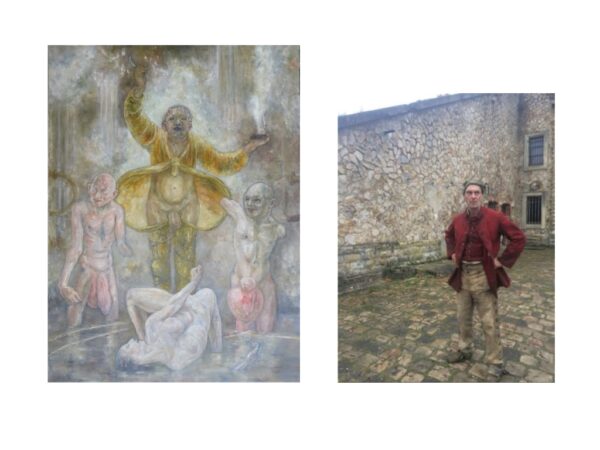
In this chapter, Cal Fraser stages a haunting yet theatrical vision inspired by classical myths, queer ritual, and grotesque pageantry. A central figure—both priest and performer—lifts his golden robe to reveal exaggerated nudity, surrounded by a circle of contorted, almost spectral male bodies. The figures blur the lines between violence, ecstasy, and ceremony, evoking both ancient Dionysian rites and post-apocalyptic theatre.
With his signature style of queer grotesque realism, Fraser creates an unsettling tableau where gender, power, and desire intertwine in the ruins of an imagined Greece. The theatricality of the scene, mirrored in the artist’s own historical costume (shown beside the painting), suggests a deliberate act of time-bending queer storytelling.
Description
In this chapter, Cal Fraser stages a haunting yet theatrical vision inspired by classical myths, queer ritual, and grotesque pageantry. A central figure—both priest and performer—lifts his golden robe to reveal exaggerated nudity, surrounded by a circle of contorted, almost spectral male bodies. The figures blur the lines between violence, ecstasy, and ceremony, evoking both ancient Dionysian rites and post-apocalyptic theatre.
With his signature style of queer grotesque realism, Fraser creates an unsettling tableau where gender, power, and desire intertwine in the ruins of an imagined Greece. The theatricality of the scene, mirrored in the artist’s own historical costume (shown beside the painting), suggests a deliberate act of time-bending queer storytelling.
Need more information? Contact us.