No products in the cart.
TV
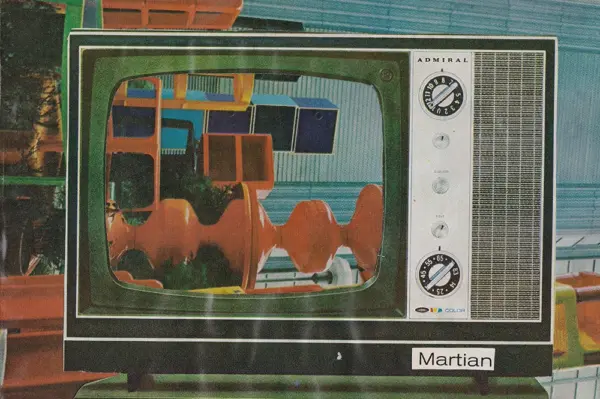
TV explores the unstable boundary between reality and mediated image, using the familiar form of a vintage television set as both frame and subject. The screen does not simply display a world—it folds space in on itself, merging interior and exterior into a single, disorienting visual field.
Curving architectural forms and saturated colors disrupt logic and perspective, suggesting a landscape that resists clear interpretation. The label “Martian” introduces a subtle estrangement, positioning the scene as alien or displaced—perhaps not from another planet, but from dominant ways of seeing and understanding.
Izer’s collage challenges the authority of media as a neutral transmitter of truth. Instead, TV becomes a site of distortion, imagination, and alternative perception—inviting viewers to question what is constructed, what is real, and who defines the frame through which we see.

Description
TV explores the unstable boundary between reality and mediated image, using the familiar form of a vintage television set as both frame and subject. The screen does not simply display a world—it folds space in on itself, merging interior and exterior into a single, disorienting visual field.
Curving architectural forms and saturated colors disrupt logic and perspective, suggesting a landscape that resists clear interpretation. The label “Martian” introduces a subtle estrangement, positioning the scene as alien or displaced—perhaps not from another planet, but from dominant ways of seeing and understanding.
Izer’s collage challenges the authority of media as a neutral transmitter of truth. Instead, TV becomes a site of distortion, imagination, and alternative perception—inviting viewers to question what is constructed, what is real, and who defines the frame through which we see.
Need more information? Contact us.